PROMOTING PLAYER DEVELOPMENT, INCLUSION, AND FAIR COMPETITION
The WESA SQs — Skills Questions for Player Assessments
Player Skills Assessments are completed once a year, typically by the end of June.
This page explains how WESA evaluates player softball skills and uses that information to create fair, inclusive competition while supporting player development.
Contents:
- Path to finalizing skills assessments
- Learning Resources & Description
- WESA Skills Assessment (SQs) Process
"WESA Athletics is about learning, not judging. We focus on developing the four core skills of softball: Hitting, Running, Fielding, and Throwing. The annual Skills Assessment is simply a tool that helps players understand their progress, recognize their strengths, and identify opportunities for growth." - WESA
Path to Finalizing Skill Assessments
The Team Coaching Pairs and the SQ Committee work hard observing league play and answering the skills questions for all members. The volunteers wrap up the process in June using this schedule.
May Field Day - Members begin to attend Field Days to self-assess their SQs
Mid-May - Team Management SQ oberservations submitted to the SQ Committee
Early June - Preliminary Assessments to team managers for feedback
June Field Day - Members continue to work with WESA Athletics on self-assessments
Mid-June - Preliminary Assessments to WESA members
End of June - Deadline for SQ Committee final Skills Questions assessments
REPORTS
View the latest SQ Reports HERE.
Learning Resources
NEW for 2026
40% Threshold for Throwing/Pitching Questions (Q21-26)
“These questions are intended to be used as a tool to assist those responsible for rating players so ratings may be fair and consistent across all levels of play and across all leagues.” — iPride Softball
Why WESA Uses the Skills Questions System
As a recreational league with members of varying abilities, WESA groups players by skill level to ensure safety, fair play, and fun for everyone. The iPride Softball player rating guidelines use a series of objective, skill-based yes/no questions. These questions assess a player's ability across distinct categories to determine their total individual rating, which dictates their eligibility for specific divisions.
All official questions begin with the phrase: "Does the player have the ability to...". A "YES" answer to any part of a multi-part question assigns that point to the player. WESA uses the questions from four categories (Hitting, Running, Fieldings, Throwing) to promote player development and fairness in eligibilty to maximize inclusion and safety.
As of the end of the 2026 season, WESA's membership was made up of 72% E-players.
Getting It Right
In 2025–26, WESA completed a multi-year process to refine how player assessments are conducted. While we continue using iPride’s benchmarked system, our approach is now unified, objective, and consistent across all divisions. The league has linked the Skills Assessment Process with our Skills Development efforts.
Previously, assessments were handled mainly by teams with limited oversight — leading to inconsistencies. Now, assessments are centralized, standardized, and conducted by trained volunteers on the SQ Committee with input from Team Management.
A key improvement: We focus on objective observation, not subjective “intangibles” like attitude or potential. The goal is accuracy, fairness, and transparency.
Video Assist - The league is running a pilot project with the SQ Committee using video to capture select game play to support the accuracy of SQ assessments. Any footage collected is used solely for the committee’s evaluation purposes.
Intangibles and Limitations
The Skills Questions are the most objective method available for evaluating softball ability, but they don’t measure everything. Team value also includes leadership, teamwork, and spirit — qualities assessed during the draft process, not through SQs.
“Our goal is to keep the league fair and fun for everyone.”
- WESA
challenging: If You Disagree With Your Assessment
If you believe your answers to the SQs are incorrect, you may challenge during the official challenge window ONLY. Each season the window to challenge will stay open for about a week after the preliminary SQs have been released to the members by email notification.
- Use the Form available during the challenge period
For challenges involving Fielding, Running or Throwing, you may have these skills assessed at a Field Day.
All challenges are best done with the consultation of your season team coaches. Their documented observations of their team players are part of the assessment process.
Do not wait. If you are a returning player and want to keep on top of your skills assessments, come to the WESA Fields Days where you can display your skills and get feedback on your progress from our WESA Athletics volunteers.
All reviews are subject to availability of qualified volunteers.
WESA SQ Process
The WESA SQ process is a collaborative effort between the player, their Team Manager, and the SQ Committee. The purpose of the process is to promote fair, consistent, and transparent player assessments that support balanced play and an inclusive and safe league experience.
The process recognizes that each participant brings a unique and valuable perspective. Players understand their own experiences and development, Team Managers observe players throughout the season, and the SQ Committee works to apply league-wide standards consistently across the membership.
The goal of the SQ process is not to rank players, but to help place them in an environment where they can compete, develop, and belong.
Role of the Player
Players are encouraged to:
Review and understand the Skills Questions;
Participate honestly in the assessment process;
Raise questions or concerns through the established review process; and
Participate in assessment opportunities or challenges when applicable.
Players provide an important perspective on their own softball experience and growth.
Role of the Team Manager
Team Managers play an essential role by:
Providing feedback based on direct observation of players during league games, practices, and team activities;
Identifying situations where a preliminary assessment may not accurately reflect a player's current abilities;
Helping players understand the purpose and intent of the Skills Questions; and
Working collaboratively with the SQ Committee during the review process.
The experience and day-to-day knowledge of Team Managers are an essential part of maintaining accurate and fair assessments.
Role of the SQ Committee
The SQ Committee is responsible for:
Applying the Skills Questions consistently across the membership;
Reviewing information provided by players and Team Managers;
Considering league-wide standards and precedents;
Promoting fairness and consistency between teams and divisions; and
Making recommendations to the League Commissioner regarding Skills Question outcomes.
The SQ Committee recognizes that the assessment process is strongest when informed by the perspectives of both players and Team Managers.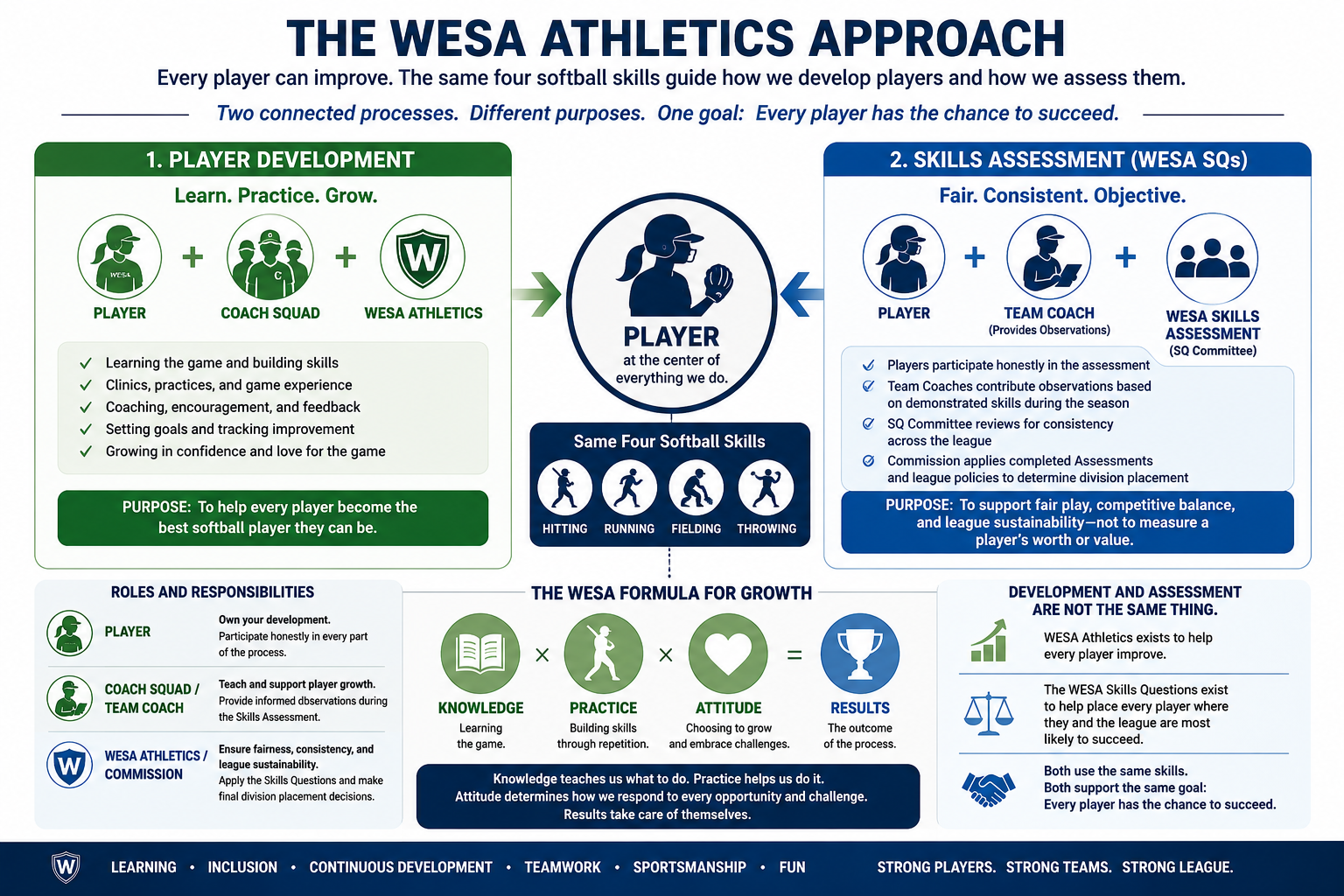
This graphic illustrates how the WESA Athletics approach for Player Development and Skills Assessment work in tandem. (click to enlarge)
Governance
The SQ Committee serves as an advisory body to the League Commissioner. After considering the collaborative input of players and Team Managers, the Committee forwards its recommendations to the League Commissioner, who is responsible for the administration of the WESA Skills Assessment process.
Guiding Principles
Collaboration
Players, Team Managers, and the SQ Committee each contribute valuable information and perspectives to the assessment process.
Consistency
Similar skills and situations are best assessed in a similar manner across the league.
Fairness
Assessments are intended to support safe & balanced play, and inclusive participation throughout WESA.
Respect
Skills Questions measure specific softball abilities. They do not measure or define a player's overall value, leadership, softball knowledge, attitude, commitment, sportsmanship, or contribution to the WESA community.
Inclusion
WESA believes that belonging and balanced competition go hand in hand. An inclusive league must also be a fair league. The Skills Assessment process may sometimes place limits on individual preferences in order to protect the experience of the broader membership and preserve confidence in the league's competitive structure.
League Sustainability
The long-term health of the league depends on balancing individual interests with the collective experience of the membership. The Skills Assessment process supports sustainable growth by promoting fair competition, encouraging player development, and maintaining confidence in the integrity of league play.
Summary
The WESA Skills Assessment process is built on the belief that the best decisions come from collaboration, open communication, and shared responsibility. By combining the perspectives of players, Team Managers, and the SQ Committee, WESA seeks to maintain a process that is fair, consistent, and supportive of every member's softball journey.
In keeping with the League's values of Inclusion, Sportsmanship, and League Sustainability, the objective is not simply to evaluate skills, but to help create teams and divisions where every player has the opportunity to compete, develop, and belong. Achieving that objective sometimes requires balancing individual preferences with the needs of the broader membership, recognizing that a league remains strongest when it is both welcoming and fair.
The WESA Skills Assessment process is founded on a simple belief: a player is more than a score, a team is more than its record, and a strong league is one where every member has a place to play while having confidence in the fairness and integrity of the game.
Sponsors